Recently, Assistant Professor Conghui Liu’s group from the College of Chemistry and Environmental Engineering, Shenzhen University, published a research paper in the Nature Index journal Advanced Functional Materials (Impact Factor: 19; CAS JCR Q1; TOP journal). The paper is entitled “Electronics-Free Wearable Platform for Computationally Guided Sweat Biomarker Recognition”. Shiyao Li, a PhD candidate from the group, is the first author of the paper. Assistant Professor Conghui Liu served as the corresponding author, and Shenzhen University is listed as the corresponding institution.
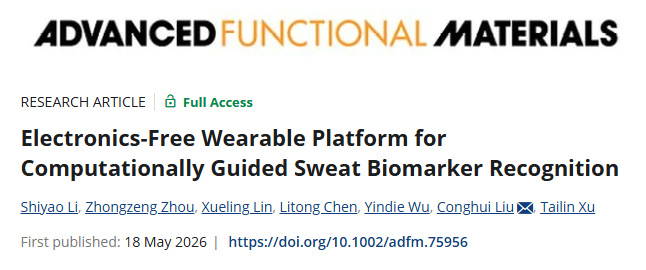
Wearable colorimetric sensors are powerful tools for noninvasive health monitoring, yet they frequently lack the necessary chemical specificity when operating in complex biofluids. Here, the research team reports report an electronics-free microfluidic wearable platform that achieves seamlessly integrated “acquisition-transduction-decoding” of sweat biomarkers. For active information acquisition, the researchers engineered a highly porous iron-vermiculite-carbon composite acting as a thermal actuator. Its optimized exothermic kinetics autonomously stimulate targeted sweat secretion (∼37°C) without external power. To ensure high-fidelity signal transduction, the researchers established an optical array driven by computationally screened supramolecular receptors. The group employed density functional theory (DFT) to map the physicochemical fingerprints of target analytes (K+, Ca2+, and uric acid), thereby rationally selecting macrocycles with precisely matched electrostatic and topological profiles and intelligently coupling them with target-specific chromogenic reporters (gold nanoparticles, dibromo-core-substituted naphthalene diimide (Br2-cNDI), and resorufin, respectively) for direct optical signal transduction. Finally, for intelligent decoding, a K-nearest neighbor (KNN) machine-learning algorithm is applied to decrypt the multiplexed multidimensional RGB outputs, achieving robust semi-quantitative profiling with exceptional classification accuracy (up to 100%). This supramolecularly engineered wearable platform establishes a computation-driven approach for selective, noninvasive detection of low-abundance sweat biomarkers, and holds strong potential for personalized preventive healthcare.

Original article: https://advanced.onlinelibrary.wiley.com/doi/10.1002/adfm.75956
Recently, the research group led by Assistant Professor Conghui Liu from the College of Chemistry and Environmental Engineering at Shenzhen University published a research paper titled "Portable Electrochemiluminescence Microarray Sensor for Machine Learning Assisted Quantitative Analysis of Zealalenone" in Analytical Chemistry (Impact Factor 6.7, JCR Q1 TOP, Nature Index journal). Dr. Romana Manzoor was the first author of the paper, Assistant Professor Conghui Liu was the corresponding author.
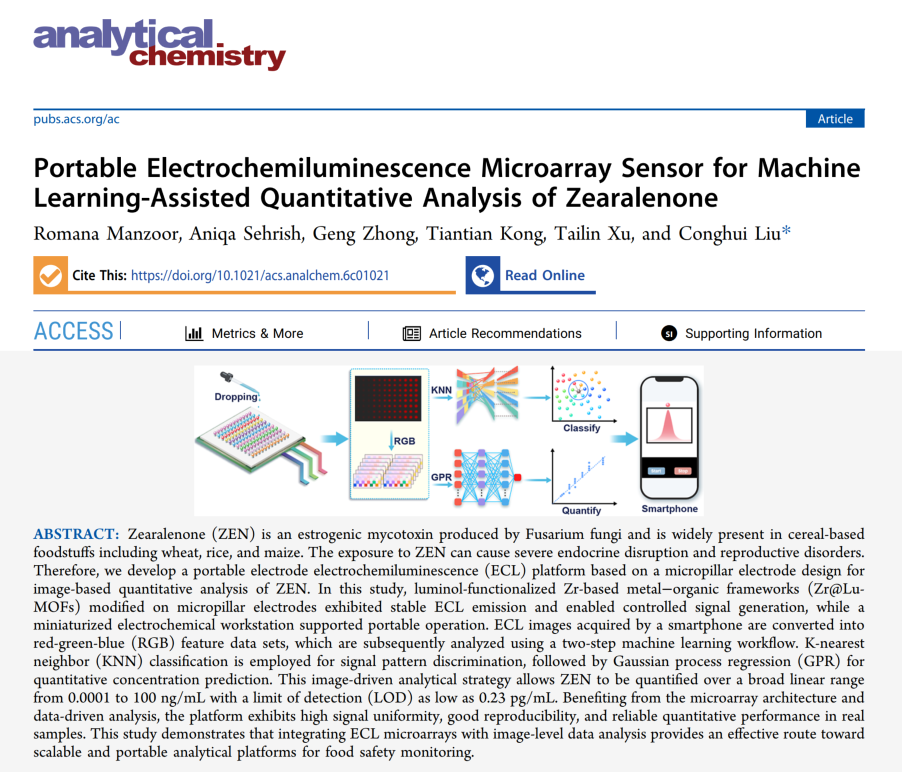
Zearalenone (ZEN) is an estrogenic mycotoxin produced by Fusarium fungi and is widely present in cereal-based foodstuffs including wheat, rice, and maize. The exposure to ZEN can cause severe endocrine disruption and reproductive disorders. Therefore, we develop a portable electrode electrochemiluminescence (ECL) platform based on a micropillar electrode design for image-based quantitative analysis of ZEN. In this study, luminol-functionalized Zr-based metal-organic frameworks (Zr@Lu-MOFs) modified on micropillar electrodes exhibited stable ECL emission and enabled controlled signal generation, while a miniaturized electrochemical workstation supported portable operation. ECL images acquired by a smartphone are converted into red-green-blue (RGB) feature datasets, which are subsequently analyzed using a two-step machine learning workflow. K-nearest neighbor (KNN) classification is employed for signal pattern discrimination, followed by Gaussian process regression (GPR) for quantitative concentration prediction. This image-driven analytical strategy allows ZEN to be quantified over a broad linear range from 0.0001 to 100 ng/mL with a limit of detection (LOD) as low as 0.23 pg/mL. Benefiting from the microarray architecture and data-driven analysis, the platform exhibits high signal uniformity, good reproducibility, and reliable quantitative performance in real samples. This study demonstrates that integrating ECL microarrays with image-level data analysis provides an effective route toward scalable and portable analytical platforms for food safety monitoring.
Original article: https://pubs.acs.org/doi/10.1021/acs.analchem.6c01021?ref=PDF

 College of Chemistry and Environmental Engineering