Recently, Professor Chuanxin He’s research group from the College of Chemistry and Environmental Engineering at Shenzhen University published a research article in Science Advances (Impact Factor: 12.5; CAS JCR Q1; Top journal) entitled “Ampere-Level Furfurylamine Electrosynthesis Enabled by High-Density Atomic Copper Sites and a Well-Engineered Electrolysis Reactor.” Dr. Weiliang Zhou is the first author, while Associate Professor Qi Hu and Professor Chuanxin He are the co-corresponding authors. Shenzhen University is the first corresponding affiliation.
Aldehyde reductive amination is an important route for the synthesis of primary amines and has broad applications in organic synthesis and fine chemical production. Primary amines are key intermediates for agrochemicals, pharmaceuticals, and high-value fine chemicals. In particular, lignocellulose-derived platform aldehydes provide renewable carbon feedstocks for the sustainable synthesis of amines. However, conventional reductive amination processes often rely on energy-intensive feedstock production routes and noble-metal catalysts, leading to high cost and energy consumption and limiting their large-scale application. Therefore, developing environmentally benign and energy-efficient routes for primary amine synthesis is of great significance. Electrosynthesis offers an attractive strategy for the green production of high-value amines, as it enables chemical transformations under mild conditions using inexpensive feedstocks and renewable electricity.
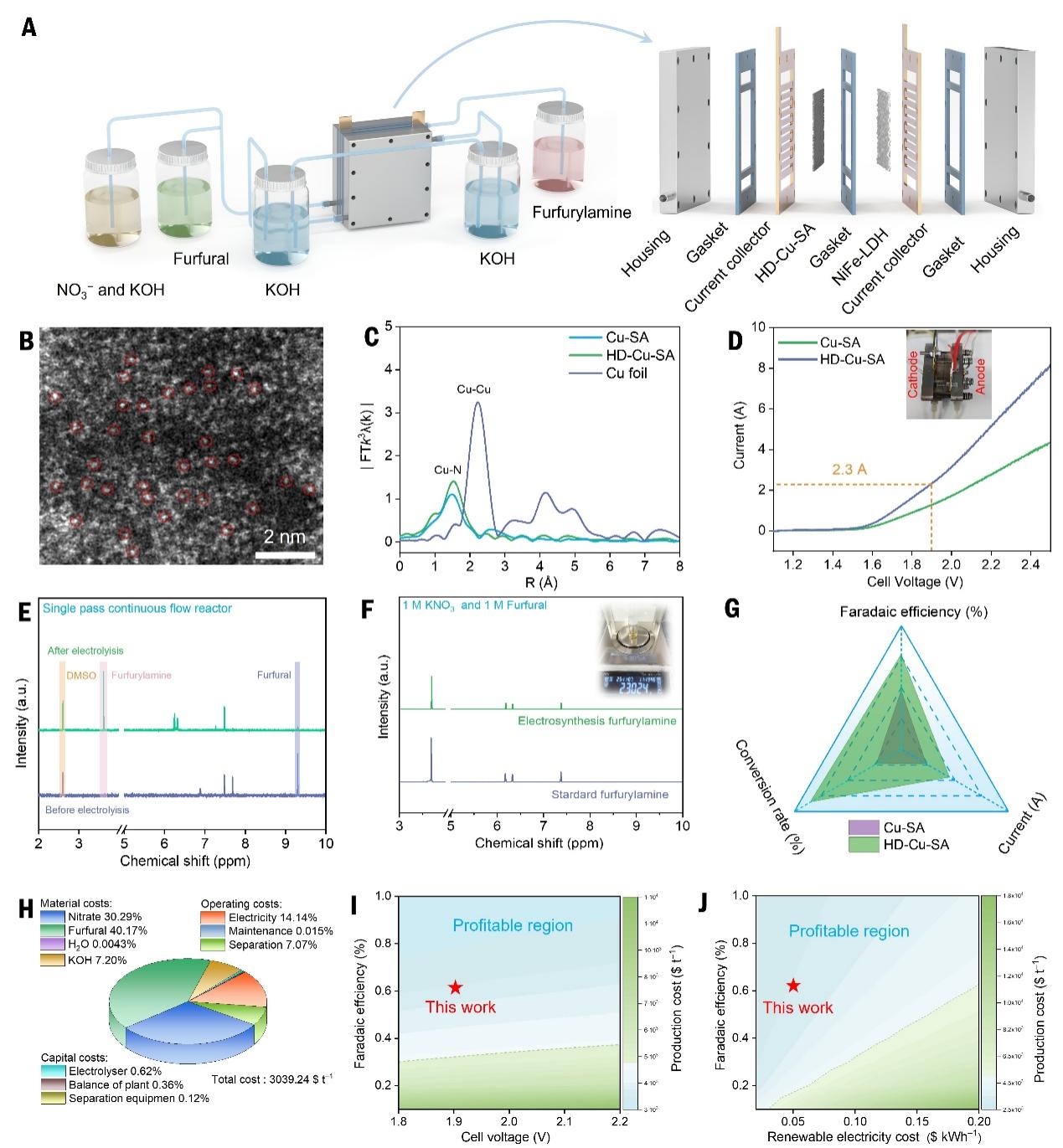
In this work, we report a new electrosynthetic strategy for producing furfurylamine through the co-reduction of furfural and nitrate. By regulating the particle size of copper catalysts, we reveal the unique role of copper single atoms (Cu-SA) in promoting the key C–N coupling step while suppressing ammonia formation. As a result, Cu-SA delivers a much higher Faradaic efficiency toward furfurylamine than copper subnanoclusters and copper nanoparticles. To further improve reaction efficiency and scalability, we prepared a high-density Cu-SA catalyst with a metal loading of up to 20 wt% and developed a single-pass continuous-flow reactor. This system uses separated feeding of furfural and alkaline nitrate solutions, shortening the residence time of furfural in alkaline media and effectively suppressing competing side reactions such as self-polymerization and disproportionation. By integrating the high-density Cu-SA catalyst with the single-pass electrolysis system, the reaction operates stably at a current of 2.3 A and produces 2.30 g of high-purity furfurylamine within 5 h. Techno-economic analysis further highlights the promising industrial potential of this electrosynthetic route. This work provides a green and scalable strategy for converting biomass-derived platform aldehydes into high-value primary amines and offers useful guidance for the broader application of electrosynthesis in fine chemical manufacturing.

 College of Chemistry and Environmental Engineering