Recently, the research group of Professor Shou-Guo Wang at the College of Chemistry and Environmental Engineering, Shenzhen University, published a significant research paper in ACS Catalysis, a leading journal in the field of catalysis. The study, entitled “Rh(III)-Catalyzed Enantioselective Multicomponent C–H Functionalization Cascade toward Chiral Indoles,” systematically reports a new strategy for the construction of chiral indole compounds through a rhodium‑catalyzed asymmetric multicomponent C–H functionalization cascade. ACS Catalysis is published by the American Chemical Society (Impact Factor: 13.6, CAS JCR Q1, Top Journal). The co‑corresponding authors are Professor Shou-Guo Wang (Distinguished Professor) and Postdoctoral Fellow Xianglin Luo, with Postdoctoral Fellow Zhongfeng Luo as the first author and Shenzhen University as the sole affiliated institution.
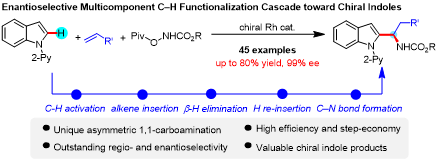
Chiral (indol-2-yl)methanamines represent privileged scaffolds found in numerous natural products and bioactive molecules; however, conventional approaches to valuable architectures typically require multistep sequences or preformed chiral building blocks and suffer from low efficiency. Despite notable advances in transition metal�catalyzed asymmetric C2–H functionalization of indoles, current methods remain largely restricted to olefinic coupling partners and operate via migratory insertion to deliver asymmetric hydroarylation products. Hence, the development of asymmetric C–H functionalization strategies for constructing structurally diverse and functionally rich chiral indole frameworks remains a significant challenge. In response, Wang Shouguo and co�workers have recently disclosed a Rh(III)-catalyzed enantioselective multicomponent C–H functionalization that directly converts readily available indoles, alkenes, and aminating agents into valuable chiral (indol-2-yl)methanamines. Orchestrated by a chiral Rh(III) catalyst, this cascade integrates indole C2–H activation, alkene chain walking, and enantioselective C–N bond formation to accomplish a rare 1,1-carboamination manifold, delivering enantioenriched indoles with high efficiency and enantiocontrol (up to 80% yield, 99% ee). This study highlights the potential of enantioselective multicomponent C–H functionalization as a versatile and efficient platform for the rapid assembly of value-added chiral architectures.
The research group is part of the Innovation Team of Chiral Catalysis and Functional Organic Molecules at the College of Chemistry and Environmental Engineering, Shenzhen University. The team is dedicated to advancing cutting-edge research in synthetic and medicinal chemistry, with a focus on developing novel and efficient synthetic methodologies and precision chiral synthesis technologies. By integrating modern organic synthesis, chiral catalysis, and synthetic biology/biocatalysis, the group has systematically established a diverse catalytic platform encompassing asymmetric catalysis, enzyme catalysis, and organometallic chemistry. Their achievements have been successfully applied to the efficient and diversity-oriented synthesis of natural products, pharmaceutically active molecules, and their derivatives.
This research was supported by the Guangdong Basic and Applied Basic Research Foundation, the Shenzhen Science and Technology Program, the Scientific Foundation for Youth Scholars of Shenzhen University, and the startup funding provided by Shenzhen University.
Original link:
https://pubs.acs.org/doi/10.1021/acscatal.6c03499

 College of Chemistry and Environmental Engineering