A research team led by Professor Shou-Guo Wang from the College of Chemistry and Environmental Engineering at Shenzhen University, in collaboration with Professor Dong Wu from the Zhuhai Institute of Advanced Technology, has published a research article in the Journal of the American Chemical Society (JACS), the flagship journal of the American Chemical Society. The article is entitled “Enantioselective Defluorinative C(sp²)–H Allylation of Acrylamides Enabled by CpˣRh(III) Catalysis.”

Chiral fluoroalkenes are valuable structural motifs in medicinal chemistry and organic synthesis. They can serve as amide-bond bioisosteres and as versatile intermediates for the preparation of structurally complex fluorinated molecules. Nevertheless, their synthesis from readily available starting materials remains challenging, particularly when selective C–H functionalization, C–F bond cleavage, and precise stereochemical control must be achieved in a single catalytic process. To address this challenge, the researchers developed a chiral CpˣRh(III)-catalyzed enantioselective defluorinative C(sp²)–H allylation of acrylamides with amide-substituted allylic gem-difluorides. Through a sequence involving alkenyl C–H activation, enantioselective migratory insertion, and β-fluoride elimination, the reaction provides direct access to chiral fluorinated skipped 1,4-dienes in yields and enantiomeric excesses of up to 99%, together with excellent regioselectivity and control of alkene geometry.
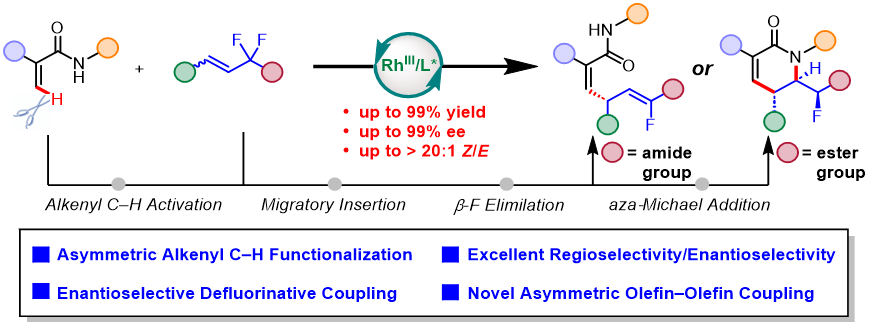
The reaction accommodates a broad range of acrylamides and allylic gem-difluorides and displays good functional-group compatibility. Substrates derived from pharmaceuticals and biologically active molecules are also suitable, demonstrating the potential of the method for the late-stage modification of complex molecules. The resulting products can be further converted into various chiral fluorinated carboxylic acids, amides, and fluoroallylic alcohols. Notably, ester-substituted allylic gem-difluorides undergo an additional intramolecular aza-Michael addition, providing chiral 2-piperidones bearing three contiguous stereogenic centers. These products are formed with up to 99% ee and greater than 20:1 diastereoselectivity, highlighting the potential of the catalytic system for constructing complex chiral nitrogen-containing frameworks. Mechanistic experiments indicate that C–H activation is reversible and that the stereochemical outcome is primarily established during migratory insertion. Subsequent β-fluoride elimination furnishes the stereodefined fluoroalkene. By combining asymmetric C–H activation with selective C–F bond cleavage, this work provides a modular platform for the synthesis of chiral fluorinated skipped dienes and 2-piperidones.
Dr. Shu-Bin Mou and Associate Researcher Mu-Peng Luo contributed equally to this work. Professor Shou-Guo Wang of Shenzhen University and Professor Dong Wu of the Zhuhai Institute of Advanced Technology are the corresponding authors. Shenzhen University is the principal institution contributing to the study.
This work was supported by the Guangdong Basic and Applied Basic Research Foundation, the Shenzhen Science and Technology Program, and start-up funding from Shenzhen University.
Article link:
https://doi.org/10.1021/jacs.6c17644

 College of Chemistry and Environmental Engineering