Recently, the research team led by Associate Professor Lijie Zhou from the College of Chemistry and Environmental Engineering at Shenzhen University published a research article titled “Functional genomic analysis reveals bacterial response of thiosulfate-driven denitrification to artificial sweetener ‘aspartame’” in Environmental Chemistry and Ecotoxicology (Impact Factor: 8.2; CAS Ranking: Q1; Top-tier journal). Associate Professor Zhou Lijie is the sole corresponding author of the paper, undergraduate student Yue Xi is the first author. Shenzhen University is both the first-author and corresponding-author affiliation.
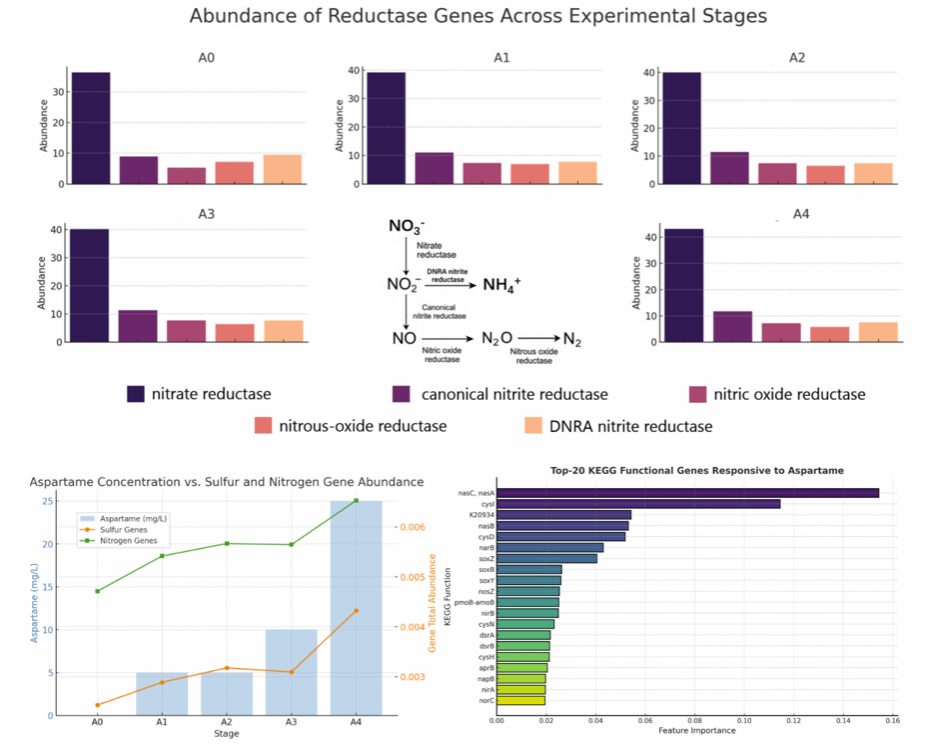
Aspartame (ASP), an artificial sweetener widely applied in sugar-free foods and beverages due to its high sweetness and low caloric content, has raised increasing environmental concerns regarding its persistence and biological toxicity as its usage expands. This study established an anaerobic thiosulfate-driven denitrification system and conducted exposure experiments with ASP at gradient concentrations ranging from 0 to 25 mg/L. The results showed that denitrification was temporarily inhibited at low ASP concentrations during the early exposure stage, reflected by the accumulation of nitrate and nitrite, with nitrogen removal efficiency dropping from 97% to a minimum of 78%. However, the system rapidly recovered its functionality, demonstrating notable resilience. Even under higher ASP loads in the later stage, the system quickly returned to stable performance. This self-repair capability originated from abundant core microbial modules represented by Thiobacillus and Rhodocyclaceae, along with enhanced expression of key nitrogen- and sulfur-related functional genes such as soxB, nar, nir, and nos. Moreover, the strong co-expression patterns between sulfur and nitrogen cycle functional genes indicated the establishment of a tightly coupled metabolic network within the system, exhibiting both resilience and thermal stability under aspartame stress. Machine learning analysis further identified nasC, aprB, soxB, and nosZ as critical stress-responsive genes, underscoring their key roles in adaptive reprogramming and ecosystem robustness. By integrating reactor performance analysis, microbial community profiling, functional gene expression, and machine learning approaches, this study provides a multi-level understanding of ASP’s effects on sulfur-driven autotrophic denitrification. The findings offer new insights into how emerging artificial sweeteners influence anaerobic biological nitrogen removal processes and provide theoretical reference for engineering applications in treating wastewater containing complex organic contaminants.
Original link: https://doi.org/10.1016/j.enceco.2025.10.028

 College of Chemistry and Environmental Engineering