Recently, Associate Professor Tilong Yang from the College of Chemistry and Environmental Engineering at Shenzhen University, in collaboration with the research group of Guosheng Liu at the Shanghai Institute of Organic Chemistry, reported new advances in asymmetric radical transformations of C–H bonds. The work, entitled Asymmetric Radical Allylic Cyanation of Electron-Deficient Alkenes with a Low Copper Catalyst Loading: Development and Mechanism, was published in the Journal of the American Chemical Society. Associate Professor Yang served as co-corresponding author and co-first author, while the College of Chemistry and Environmental Engineering at Shenzhen University was listed as the second affiliated institution.
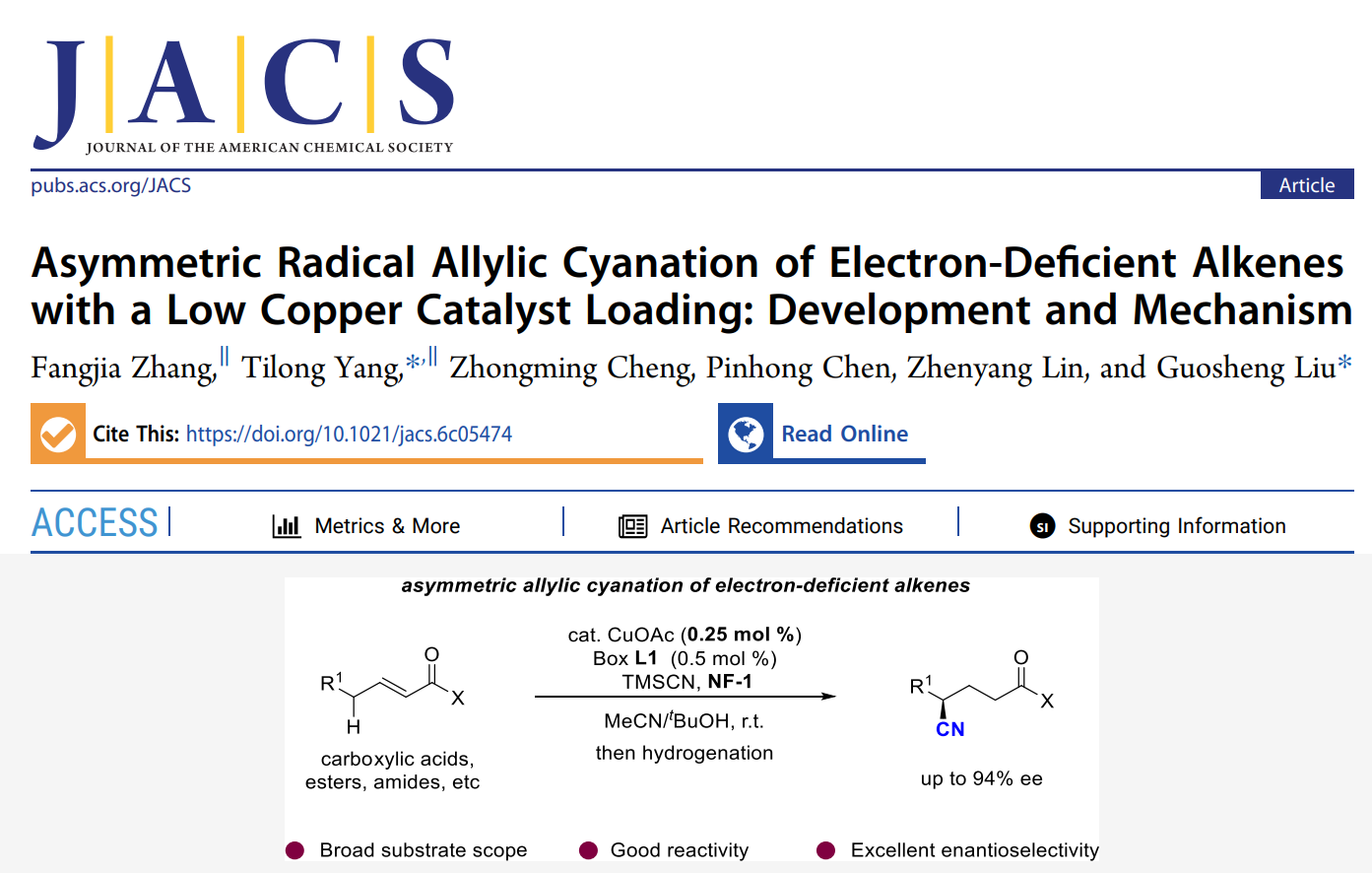
Radical-involved transition-metal catalysis has greatly expanded the scope of reaction types and transformation modes available in organic synthesis. However, the high reactivity of radical species often leads to undesired side reactions and challenges in selectivity control, particularly in asymmetric C–H bond functionalization, which remains a major challenge in the field. Associate Professor Yang and Professor Liu’s team have established a strong collaborative foundation in this area and have achieved a series of advances in catalytic system development, mechanistic studies, and radical theory. Representative works have been published in Nature Catalysis 2025, 8, 58; Journal of the American Chemical Society 2025, 147, 14756; Journal of the American Chemical Society 2023, 145, 25995; and Journal of the American Chemical Society 2021, 143, 14451.
To address the low radical reactivity and competing side reactions encountered in allylic C–H bond transformations of electron-deficient alkenes, the research team developed two synergistic control strategies. First, by tuning the interaction strength between the radical intermediate and the metal center, they achieved the transformation from a “metal-bound radical” to a “free radical,” thereby enhancing radical reactivity. Second, by reducing the copper catalyst loading, they effectively suppressed competing side-reaction pathways. Based on these strategies, the team successfully realized the first asymmetric allylic C–H cyanation of electron-deficient alkenes.
Mechanistic studies revealed that the dynamically tunable interactions between radicals and metal centers not only govern reactivity and selectivity, but also play a critical role in determining the competition between productive and side-reaction pathways within the catalytic cycle. This work provides new theoretical insights into the design of asymmetric radical catalytic systems and offers new directions for the development of asymmetric functionalization reactions of other types of C–H bonds.
Paper link: https://doi.org/10.1021/jacs.6c05474

 College of Chemistry and Environmental Engineering