Recently, the research team led by Deng Libo from the School of Chemistry and Environmental Engineering at Shenzhen University published a research paper titled "Pulsed Charging-Induced Interfacial Stabilization Enables Highly Stable Iron Phosphate Electrode for Ultrafast Electrochemical Lithium Extraction" in the journal "Angewandte Chemie" (Impact Factor 17.6, Q1 of Chinese Academy of Sciences, TOP journal). The doctoral student Wang Ziquan from the research team is the first author of the paper, and Associate Professor Deng Libo from Shenzhen University and Professor Yamauchi from the University of Queensland are co-corresponding authors. Shenzhen University is the leading correspondence institution.
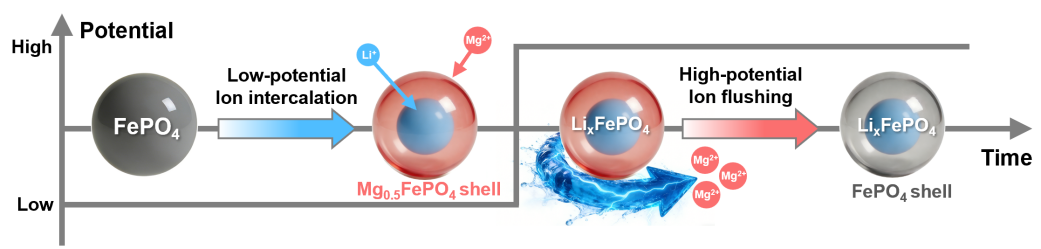
Amid the soaring global demand for lithium, electrochemical lithium extraction using iron phosphate (FePO4) electrodes is promising, yet its practical application in salt lake brines is severely constrained by high Mg2+/Li+ ratios. Herein, we unravel the intrinsic degradation mechanism by demonstrating that Mg2+ intercalation weakens the Fe–O bonds in FePO4, triggering Fe2+ dissolution, and inducing the formation of Fe2O3 surface species that deteriorate electrode performance. To tackle this critical challenge, we propose a novel pulsed charging protocol where reverse potentials not only efficiently flush out surface-intercalated Mg2+ but also enrich Cl⁻ on the electrode surface, thereby modulating the electronic structure and lowering the Mg2+ deintercalation barrier. The FePO4||Ag cell integrated with this protocol exhibits superior Li+ extraction kinetics (~20 mg g−1 h−1), high LiCl product purity (99.95%), and exceptional cycling stability (800 h operation with ~80% performance retention) in real salt lake brines. This work establishes a theoretical basis for electrode protection and provides a robust strategy to advance high-efficiency electrochemical lithium extraction.
This work was supported by Shenzhen Science and Technology Program, National Natural Science Foundation of China (22478249) and National Natural Science Foundation of Guangdong Province.
https://doi.org/10.1002/anie.1780372

 College of Chemistry and Environmental Engineering