Recently, Professor Lijie Zhou’s team from the College of Chemistry and Environmental Engineering at Shenzhen University published a research article entitled “ ‘Protector’ DNRA bacteria, shielding anammox systems from perfluorooctanoic acid by mitigating nitrite accumulation” in Bioresource Technology (impact factor 9.0; CAS/JCR Q1; top-tier journal). In this paper, Associate Professor Lijie Zhou served as the first author and the sole corresponding author, and Shenzhen University was listed as both the first-author affiliation and the corresponding-author institution.
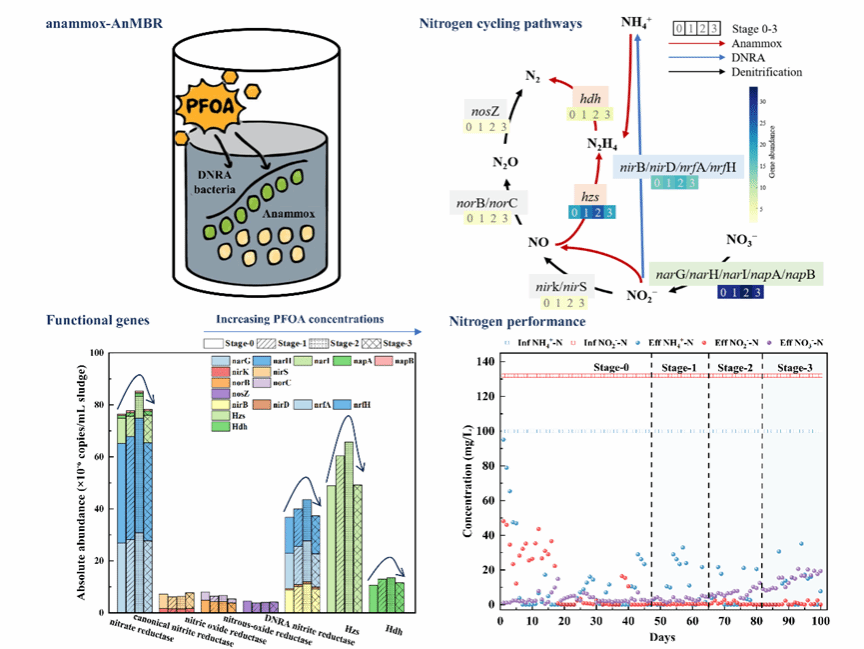
This study focuses on the effects of perfluorooctanoic acid (PFOA), a representative PFAS compound, on anammox-based nitrogen removal. The authors established a lab-scale anammox-AnMBR operated under strictly anoxic conditions with continuous feeding of synthetic wastewater. The reactor was first started up and acclimated under PFOA-free conditions (Stage-0, 0mg/L), after which influent PFOA was stepwise increased to 0.25mg/L (Stage-1), 0.50mg/L (Stage-2), and 0.75mg/L (Stage-3). System performance, sludge physicochemical properties, microbial community structure, and functional gene profiles were evaluated across these stages. The results showed that after PFOA dosing, effluent NO2--N remained near zero over the long term, whereas effluent NH4+-N fluctuated and exhibited an upward trend at the highest PFOA level. Comparatively, NO2--N removal in Stages 1-3 remained consistently high (≈99-100%), markedly higher than that in Stage-0 (≈90%), while NH4+-N removal peaked at 94% in Stage-2 and decreased to 91% in Stage-3,both higher than the 88% observed in Stage-0. These findings suggest the existence of a threshold range in which approximately 0.5mg/L PFOA can enhance anammox activity. Mechanistically, PFOA induced defensive responses and altered material partitioning in the system, sludge EPS increased substantially, with average PS rising from 33.28 to 111.06mg/gVSS and PN from 3.00 to 247.55mg/gVSS. Meanwhile, MLVSS increased to 8.17g/L in Stage-2 but dropped to 5.42g/L in Stage-3, while aqueous TOC continuously increased from 15.52 to 35.04mg/L, implying that high PFOA levels may cause cell damage or death and release intracellular organics and EPS, which are subsequently transformed into soluble products and accumulate as TOC. Metagenomic analysis indicated that the community was dominated by Planctomycetes, and the typical anammox genus Candidatus Brocadia exhibited a biphasic response, increasing slightly at low PFOA (0.25-0.5mg/L) but declining at 0.75mg/L. Functionally, related genes of nitrate reductase were the most abundant, and the proportion of anammox marker genes (hzs and hdh) increased from 23.9% to 31.8% in Stage-2 before decreasing to 24.4% in Stage-3. Integrating nitrogen stoichiometry with functional gene dynamics, the study infers a cooperative interaction between DNRA and anammox: within the threshold range, PFOA promotes key nitrogen transformations, enabling DNRA to buffer nitrite accumulation by converting NO2- and replenishing NH4+, thereby acting as a protector of the anammox process and sustaining efficient nitrogen removal under PFAS stress. However, once PFOA exceeds the threshold, both DNRA and anammox are inhibited.
Original link:https://doi.org/10.1016/j.biortech.2025.133898

 College of Chemistry and Environmental Engineering