Recently, Shiyao Li and Xueling Lin from the College of Chemistry and Environmental Engineering, Shenzhen University, published a research paper as co-first authors in the Nature Index journal Analytical Chemistry (Impact Factor: 6.7; CAS JCR Q1; TOP journal). The paper is entitled “A Wearable Supramolecular Fingertip Sensor for Colorimetric Detection of Food-Derived Tyramine”. The study was completed under the joint supervision of Assistant Professor Conghui Liu and Associate Professor Tailin Xu, who served as co-corresponding authors.
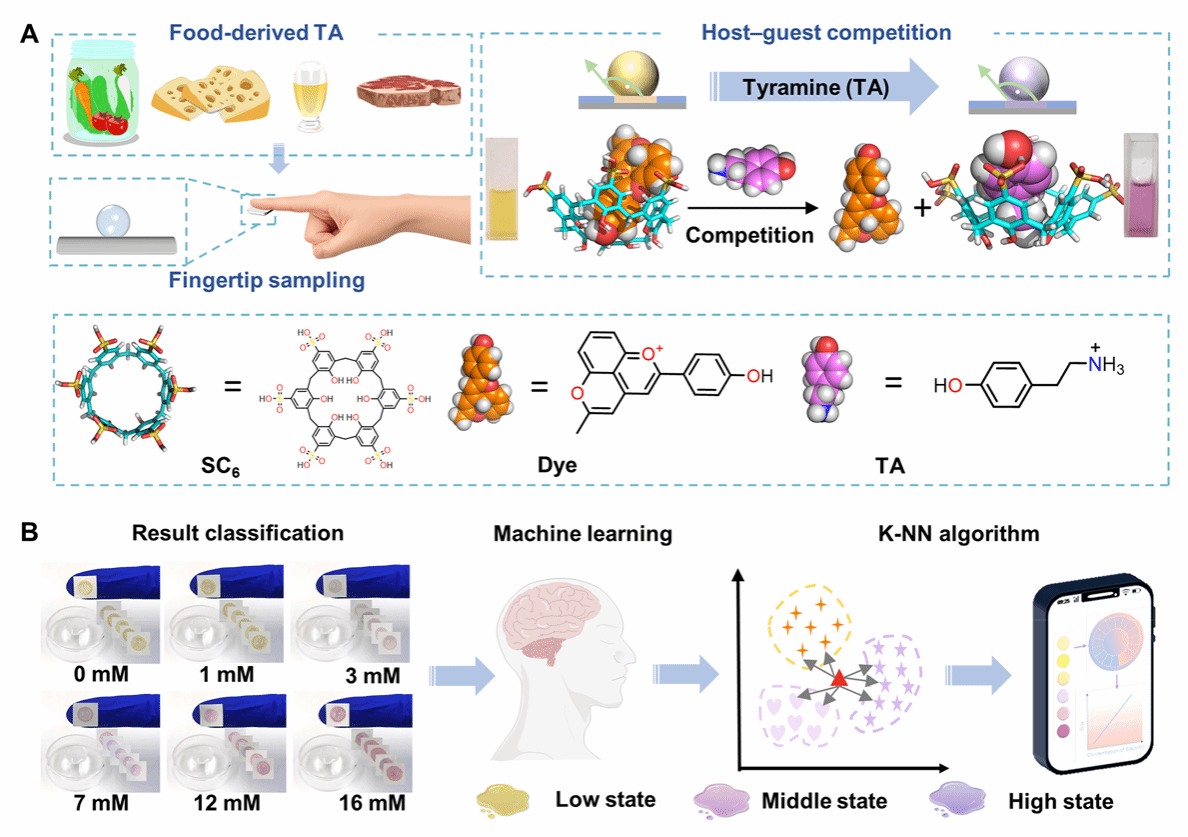
Wearable sensing technologies are emerging as promising tools for rapid on-site screening and process monitoring, owing to their direct and user-friendly human-device interfaces. However, achieving rapid, selective, and visually interpretable early warning detection in wearable formats remains challenging. In this study, we propose a fingertip-compatible supramolecular colorimetric platform based on an indicator displacement assay (IDA) for the rapid detection of tyramine (TA), a representative biogenic amine in fermented foods. A pH-responsive dye precomplexed with 4-sulfonic calix[6]arene (SC6) was immobilized within hydrophilic microdomains on POTS-TiO2-modified hydrophobic paper; strong capillary anchoring confined the sample droplet within these microreactors and inhibited lateral diffusion. Upon TA exposure, SC6 preferentially binds to amines, displacing the dye and inducing a local pH increase, which drives dye deprotonation and leads to a significant colorimetric shift. Smartphone-extracted RGB analysis showed a linear relationship between R/G and TA concentration. Furthermore, K-nearest neighbor (K-NN) classification achieved accuracies of 98.9% (R/G) and 100% (G/B). Integrated into a glove fingertip, this platform enables a rapid, reagent-efficient, and field-deployable “touch-to-detect” wearable sensing workflow. This strategy provides a powerful and practical tool for rapid on-site screening, real-time process monitoring, and early warning in amino acid fermentation and food spoilage.
This work was supported by the Shenzhen Science and Technology Program (JCYJ20240813142503006), the Shenzhen Medical Research Fund (A2403003), the Synthetic Biology Research Center of Shenzhen University, the Key Laboratory of Marine Microbiome Engineering of Guangdong Higher Education Institutes (2024KSYS011), the Shenzhen Overseas Talent Program, and the Instrument Analysis Center of Shenzhen University.
Original article: https://pubs.acs.org/doi/10.1021/acs.analchem.5c08158

 College of Chemistry and Environmental Engineering