Carbon fiber reinforced thermoplastic polyether ether ketone (CF/PEEK) laminates offer excellent light weight and high strength, corrosion resistance, high-temperature resistance, and recyclability, making them highly promising for strategic frontier fields such as aerospace, defense, high-end equipment, and humanoid robotics. However, during service, CF/PEEK laminates are subjected to various impact loads that can lead to interlaminar cracking and other damage. Additionally, next-generation equipment demands new functionalities such as electromagnetic interference (EMI) shielding and high electrical/thermal conductivity for high-power electronic devices. The single property of existing carbon fiber composites can hardly meet the comprehensive requirements in extreme environments and operating conditions. Therefore, there is an urgent need to develop CF/PEEK composites that integrate both structural and functional properties.
The research team of Huichao Liu, Caizhen Zhu, and Jian Xu at Shenzhen University has focused on the core challenge of traditional CF/PEEK laminates — the difficulty in balancing interlaminar performance and functional properties. Leveraging the three-dimensional (3D) structure of tetrapod-shaped zinc oxide whiskers (T-ZnO) and the high electrical conductivity of Ti₃C₂Tₓ MXene, they prepared MXene nanosheet-decorated T-ZnO whiskers (T-ZnO@MXene) via an electrostatic assembly strategy and introduced them into CF/PEEK laminates. The rigid anchoring effect of T-ZnO, combined with the high conductivity of MXene, synergistically optimizes interlaminar performance while constructing a 3D conductive/reinforcing network. This simultaneously and significantly improves the interlaminar performance, EMI shielding effectiveness, and electrothermal de-icing performance of CF/PEEK laminates.

On April 3, 2026, the related findings were published in the internationally renowned journal Composites Science and Technology (IF: 9.8) under the title "Simultaneous improvement in-plane mechanical performance and impact resistance of CF/PEEK composites via constructing a gradient modulus interphase". The first author of the paper is Luo Yutai (Master's graduate from Shenzhen University), and the co-first author is Cui Jinze (Master's graduate from Shenzhen University, currently a Ph.D. student at the Chengdu Institute of Organic Chemistry, Chinese Academy of Sciences). Shenzhen University is the first corresponding affiliation for this article, and Assistant Professor Liu Huichao and Professor Zhu Caizhen are the corresponding authors.
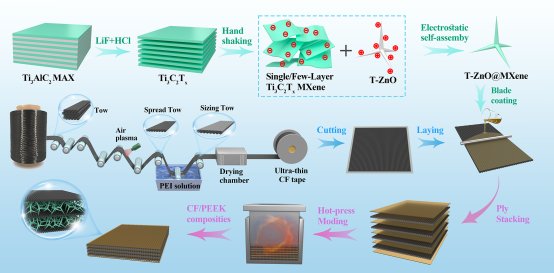
Figure 1. Preparation flowchart of CF/T‑ZnO@MXene/PEEK composites.
Based on previous research, the team systematically carried out a series of works to fully construct the structural‑functional integrated CF/T‑ZnO@MXene/PEEK composites:
Plasma‑treated and spread carbon fibers were impregnated with PEI sizing to prepare CF/PEI UD tapes.
MXene nanosheets etched from Ti₃AlC₂ (LiF/HCl) were coated onto T‑ZnO whiskers via electrostatic assembly to obtain T‑ZnO@MXene slurries with varying MXene loadings.
The slurries were doctor‑blade coated onto CF/PEI UD tapes, alternately stacked with PEEK films, and hot‑pressed into composites.
The effects of T‑ZnO@MXene on microstructure, surface properties, mechanical performance, conductivity, EMI shielding, and electrothermal de‑icing were systematically studied, and the enhancement mechanism was clarified.

Figure 2. Structural characterization of T‑ZnO@MXene.
The successful preparation and structural stability of T‑ZnO@MXene were confirmed by SEM, XRD, XPS, and zeta potential.
Etching and exfoliation produced ultrathin layered Ti₃C₂Tₓ MXene nanosheets. The dispersion showed good film‑forming ability and the Tyndall effect, indicating excellent colloidal stability.
T‑ZnO whiskers exhibited well‑defined morphology, and their 3D structure provided an ideal substrate for uniform MXene coating.
XRD confirmed the conversion of MAX phase to MXene with increased interlayer spacing, and no impurity peaks or phase transformation in the hybrid.
XPS detected characteristic Zn 2p and Ti 2p peaks, confirming the hybrid structure.
The opposite surface charges of MXene (−38.7 mV) and T‑ZnO (+8.6 mV) enabled electrostatic self‑assembly into a stable heterostructure.

Figure 3. Mechanical properties of CF/PEEK composites.
The introduction of T‑ZnO at different contents improves the interlaminar shear strength (ILSS) of CF/PEEK laminates. Specifically, the CF/4.5T/PEEK laminate exhibits an ILSS of 100.0 MPa, which is 27.1% higher than that of the CF/0.0T/PEEK laminate. This enhancement is attributed to the anchoring effect of the tetrapod‑shaped T‑ZnO between adjacent layers of the laminate. T‑ZnO modified with different MXene contents shows a similar reinforcing effect. The CF/4.5T‑3M/PEEK composite achieves a flexural strength of 1970.0 MPa and an ILSS of 123.2 MPa, corresponding to increases of 33.4% and 56.7%, respectively, compared with the unmodified sample.
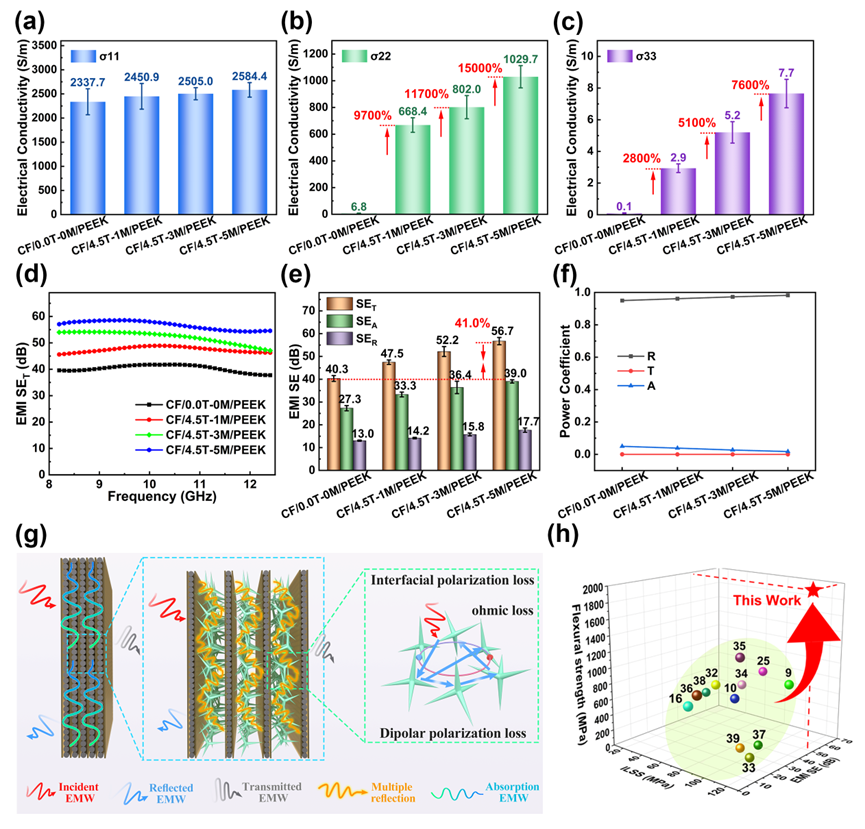
Figure 4. Comparison of EMI shielding performance, flexural strength, and interlaminar shear strength of CF/PEEK composites with literature reports.
The introduction of T‑ZnO@MXene enhances the electrical conductivity of CF/PEEK composites. Longitudinal conductivity increases by 10.6%, while transverse and through‑thickness conductivities increase by 150 and 76 times, respectively, due to the 3D conductive network. In the X‑band (8.2–12.4 GHz), CF/4.5T‑5M/PEEK achieves an EMI SE of 56.7 dB, 40.7% higher than the unmodified sample, far exceeding the commercial standard (20 dB) and approaching the military requirement (60 dB), blocking 99.999% of incident waves. The shielding follows a “surface reflection + internal absorption” mechanism, with the tetrapod T‑ZnO forming a 3D nanonetwork for enhanced energy dissipation. Compared with reported CF/PEEK composites, our structural‑functional integrated composite shows superior overall performance: flexural strength of 1970.3 MPa, ILSS of 123.2 MPa, and EMI SE of 52.2 dB, outperforming most literature counterparts. This composite provides a new solution for lightweight, multifunctional advanced engineering structures, with significant application value in aerospace and high‑end equipment manufacturing.

Figure 5. Electrothermal conversion performance of CF/PEEK composites.

Figure 6. Electrothermal de‑icing performance of CF/PEEK composites.
CF/4.5T‑5M/PEEK exhibits stable electrothermal conversion: under 2.5 V, steady‑state temperature reaches 184.9 °C, with fast response (within 50 s) and wide adjustable range (30–180 °C). At the same voltage, it completely melts ice in 196 s with a de‑icing rate of 0.612 g·min⁻¹, much superior to pristine CF/PEEK (698 s).
Through a facile and scalable electrostatic assembly strategy, a T‑ZnO@MXene 3D reinforcing/conductive network is constructed, synergistically enhancing the interlaminar, EMI shielding, and de‑icing performances of CF/PEEK laminates. This work provides both theoretical basis and practical reference for developing high‑performance structural‑functional integrated CF/PEEK composites, and opens a new pathway for the synergistic application of MXene and T‑ZnO in composites. The resulting composites, with excellent mechanical, EMI shielding, and electrothermal de‑icing properties, offer a new solution for lightweight, multifunctional advanced engineering structural components, holding significant industrial application value in aerospace, high‑end equipment manufacturing, and beyond. This work was supported by the Natural Science Foundation of Guangdong Province, the Shenzhen Natural Science Foundation, etc.
Paper Information:Yutai Luo#, Jinze Cui#, Changqiang Jia, Lingcong Kong, Feng Bao, Jiali Yu, Xiaofang Liu, Chaoyi Peng, Caizhen Zhu*, Jian Xu, Huichao Liu*. Synergistic mechanical, EMI shielding, and deicing performance of CF/PEEK composites enabled by T-ZnO@

 College of Chemistry and Environmental Engineering