Recently, the research team led by Associate Professor Zhou Lijie from the College of Chemistry and Environmental Engineering at Shenzhen University published a research paper titled "Revealing mechanism of Fe2+ supplementation on the bacterial community and its functional genes during simultaneous reductions of selenate and nitrate in a hydrogen-based membrane biofilm reactor" in the journal "Chemical Engineering Journal" (impact factor 13.2, JCR 1st zone of the Chinese Academy of Sciences, TOP journal). Associate Professor Zhou Lijie is the corresponding author and the first author of the paper, and Shenzhen University is the first author's institution and the corresponding institution.

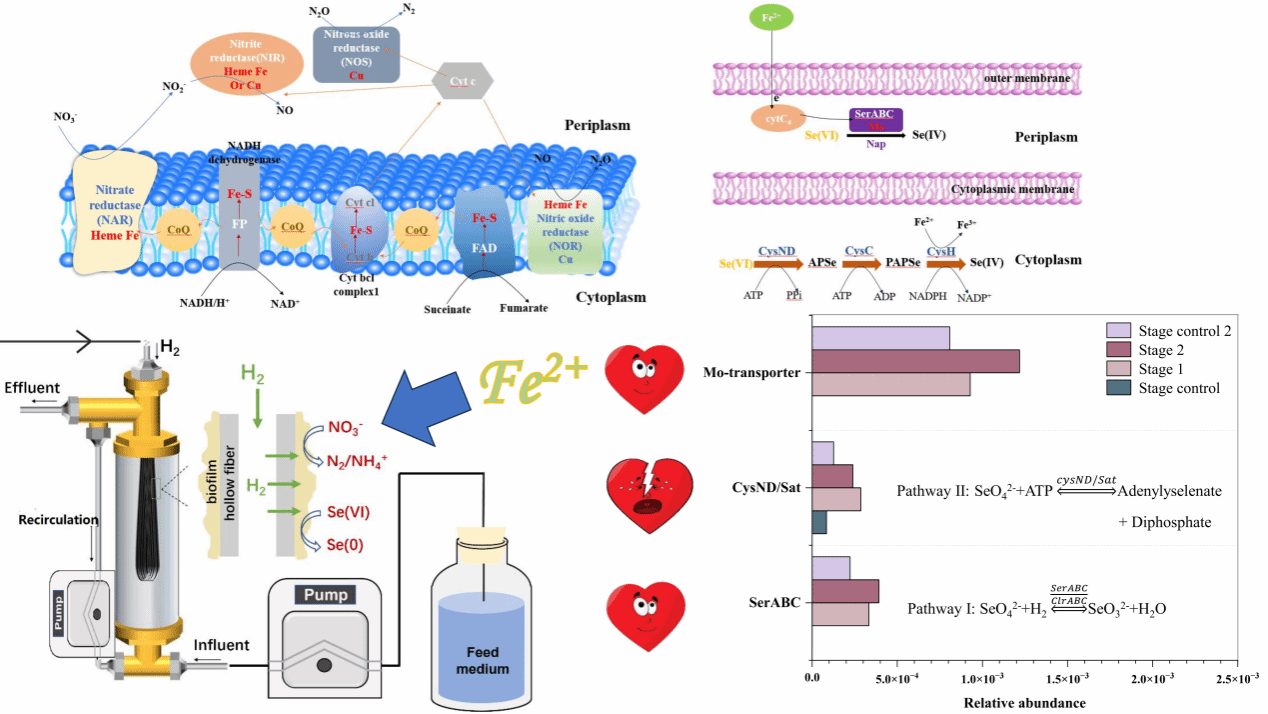
The hydrogen-based membrane biofilm reactor (H2-MBfR) uses hydrogen gas as a clean electron donor and has advantages such as "no organic residue, low sludge production, and the ability to reduce various oxidized pollutants". However, its synergistic reduction performance is highly sensitive to trace elements in the system and the biofilm electron transfer process, especially when seleniumate (SeO42-) and nitrate (NO3-) coexist. How to achieve stable and efficient simultaneous reduction through nutritional conditions still lacks a mechanism explanation. In this study, a laboratory-scale H2-MBfR was constructed, with an influent NO3- concentration of 5 mg N/L and SeO42- concentration of 0.5 mg Se/L. A staged Fe2+ addition strategy (0.2 → 1 → 5 mg/L, then back to 0.2 mg/L) was adopted to systematically evaluate its regulatory effect. The results showed that as the Fe2+ concentration increased from 0.2 mg/L to 5 mg/L, the reduction efficiency of SeO₄²⁻ significantly increased from 86% to nearly 100%, while the NO3- removal rate remained above 95%; when Fe2+ was restored to 0.2 mg/L, the removal of SeO42- decreased to approximately 60%, verifying the reversible and decisive contribution of Fe2+ to the enhancement of Se(VI) reduction. Metagenomic analysis revealed that high Fe2+ significantly reshaped the community structure: Dechloromonas, which carries key genes for denitrification and Se(VI) reduction, enriched and became the dominant genus (relative abundance reached 25.8%), while autotrophic denitrifying bacteria such as Acidovorax and Azonexus increased with the increase of Fe2+. At the functional gene level, Fe2+ addition promoted the upregulation/enrichment of key enzyme genes related to NO3- reduction and Se(VI) reduction, especially the enhancement of SerABC and Mo-transporter gene, which was highly consistent with the improvement of NO3- removal. Mechanistically, Fe2+ supported the formation of Fe-S clusters and heme and metal cofactors, strengthened the respiratory chain and interface electron transfer/buffering capacity, thereby "tightening" the coupling between the H2 phase - biofilm - terminal electron acceptor, improving the effective distribution of electrons to the reduction modules such as SerABC, and ultimately achieving the simultaneous and efficient reduction of NO3- and SeO42-. This study revealed the intrinsic laws of Fe2+ supplementation enhancing the simultaneous removal of oxygen-containing anion pollutants in H2-MBfR from multiple levels of "performance - community - functional genes - mechanism", providing a theoretical basis for the nutritional regulation and process optimization of low-carbon bioremediation processes such as groundwater.
Original link:https://doi.org/10.1016/j.cej.2025.172011

 College of Chemistry and Environmental Engineering