Recently, He Qinghua's team from the College of Chemistry and Environmental Engineering, Shenzhen University, has achieved a series of significant results in the field of phenomics technology and application. The related studies have respectively promoted the in-depth development of phenomics technology in the field of food science from the perspectives of macroscopic overview and key technological breakthroughs.
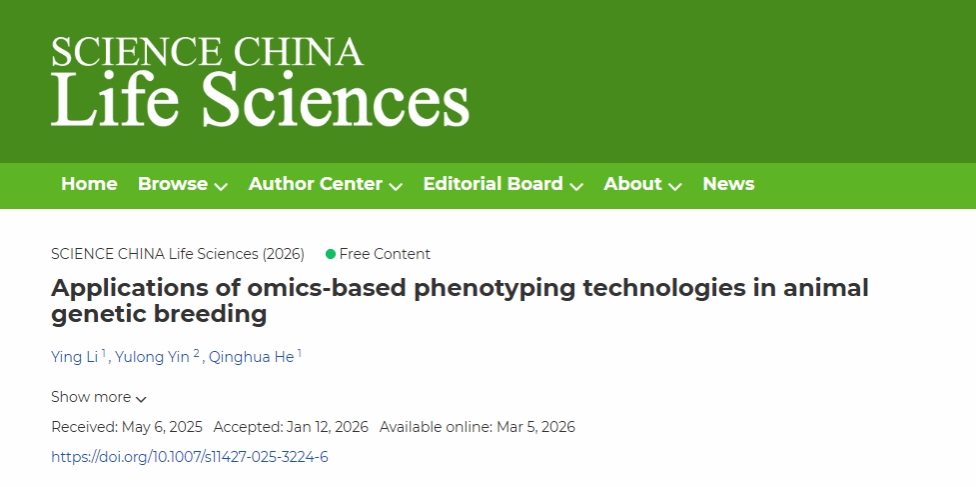
Li Ying, a master’s student of the Class of 2023 at the College of Chemistry and Environmental Engineering, Shenzhen University, published a review paper as the first author in the life sciences journal SCIENCE CHINA Life Sciences (Impact Factor: 9.5, CAS Q1, TOP journal). The paper is entitled “Applications of omics-based phenotyping technologies in animal genetic breeding”. Associate Professor He Qinghua from the College of Chemistry and Environmental Engineering, Shenzhen University and Academician Yin Yulong from the Institute of Subtropical Agriculture, the Chinese Academy of Sciences were the co-corresponding authors of the paper. Shenzhen University is listed as the first corresponding institution. Traditional selective breeding relies on observable phenotypic traits. Recent advances in omics technologies (e.g., genomics, transcriptomics, proteomics, and metabolomics) have revolutionized phenotyping in animal genetic breeding by providing deeper insights into complex traits and improving the efficiency of breeding programs. This review summarizes the applications of omics-based phenotyping technologies to improve the phenotypic traits, such as meat, egg, milk and wool quality, as well as yield, disease resistance and stress tolerance. Integrative multi-omics data enable the identification of key candidate genes, biomarkers and regulatory networks, thereby allowing earlier and more precise selection in breeding programs. The adoption of omics-driven strategies is accelerating the genetic enhancement of the economically important traits, offering a comprehensive framework to improve animal productivity and health. Nevertheless, significant challenges remain, including constructing species and traits-specific omics databases, establishing robust correlations between omics-derived phenotypes and traditional traits, and translating omics discoveries into practical breeding solutions.

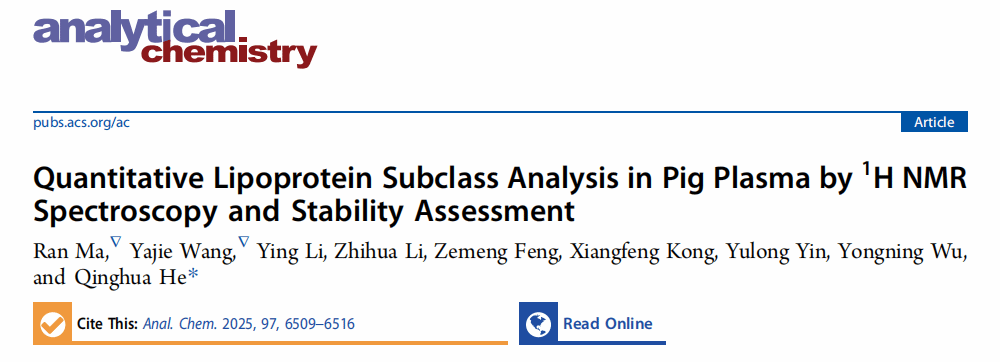
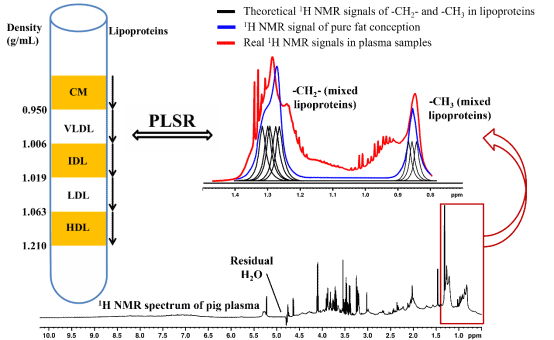
In the key technical aspects that facilitate the practical application of phenomics, He Qinghua's team published a research paper in Analytical Chemistry (Impact Factor: 6.7, CAS Q1, Nature Index journal). The paper is entitled “Quantitative Lipoprotein Subclass Analysis in Pig Plasma by 1H NMR Spectroscopy and Stability Assessment”. The 22nd-grade master's student Ma Ran and the 21st-grade master's student Wang Yajie are the co-first authors of this paper. Associate Professor He Qinghua is the independent corresponding author of this paper, and Shenzhen University is listed as both the first and the independent corresponding institution. This study explores, for the first time, the accurate prediction of lipoprotein subclasses in pig plasma by a partial least-squares regression (PLSR) model based on the optimization of the 1H NMR detection method. The 1H NMR-based detection method of plasma metabolites was optimized and evaluated. The coefficients of variation for intraday and interday detection were less than 5%, and there were no obvious metabolic differences among repeated tests of plasma samples. The variability of plasma metabolite detection based on 1H NMR revealed the consistent and stable performance of NMR methods, and the prediction models for a total of 116 subclasses in four lipoprotein classes including plasma very-low-density lipoprotein, low-density lipoprotein, intermediate-density lipoprotein, and high-density lipoprotein were established combining 1H NMR spectra and PLSR models using the data from the ultracentrifugation method. The cross-validation results showed that the PLSR prediction models for 107 lipoproteins’ main and subfractions performed excellently (R2 > 0.5), which met the method requirements. The PLSR models for the remaining nine lipoprotein major components and subcomponents performed well (0.2 < R2 < 0.5), which basically met the method requirements. According to the PLSR models based on 1H NMR, the concentrations of lipoprotein subclasses were predicted, including APO A1 (277.84-731.4 μg/mL), APO B (11.97-431.5 μg/mL), PL (142.36-1100.76 ng/mL), TG (70.21-915.35 μmol/L), CH (1313.56-6761.79 μmol/L), FC (6.37-93.06 μmol/L), and CE (1319.93-6854.85 μmol/L). Therefore, the 1H NMR-based method for the detection of lipoprotein subclasses in pig plasma was successfully established and could provide the methodological basis for the research on molecular mechanism, function, and application of lipoprotein subclasses.
This work was supported by the National Key Research and Development Project (2022YFD1300904, 2022YFC3400704), the Shenzhen Science and Technology Program (ZDSYS20210623100800001, KCXFZ20240903093600002, ZDCYKCX20250901092402003, ZDCYKCX20250901091504005), the National Natural Science Foundation of China (22193064, 22078198), the Natural Science Foundation of Guangdong Province (2024A1515010489,2025B0202130002), the Special Commissioner for Rural Science and Technology of Guangdong Province (KTP20240382) and Guangdong Province's Science and Technology Support for the "Hundreds of Counties, Thousands of Towns, and Millions of Villages Project" (2025D030).
Original article: https://doi.org/10.1021/acs.analchem.4c05881
https://www.sciengine.com/SCLS/doi/10.1007/s11427-025-3224-6

 College of Chemistry and Environmental Engineering